Was Trudeau’s Friendly Warm Social Dinner with Trump a Breakthrough?

Patrick Gossage • December 4, 2024

Let’s get real. Indeed, most agree that Trudeau’s taking up Trump’s invite to a Friday dinner invite to Mar a Lago made during his Monday phone call with the incoming President was a coup. It made Poilievre’s day-after nasty criticisms seem foolish. This is certain: there is no world leader that does not envy Justin and his gang spending over three hours at dinner with the incoming president and a few appointed heavies. Only weeks before his inauguration.
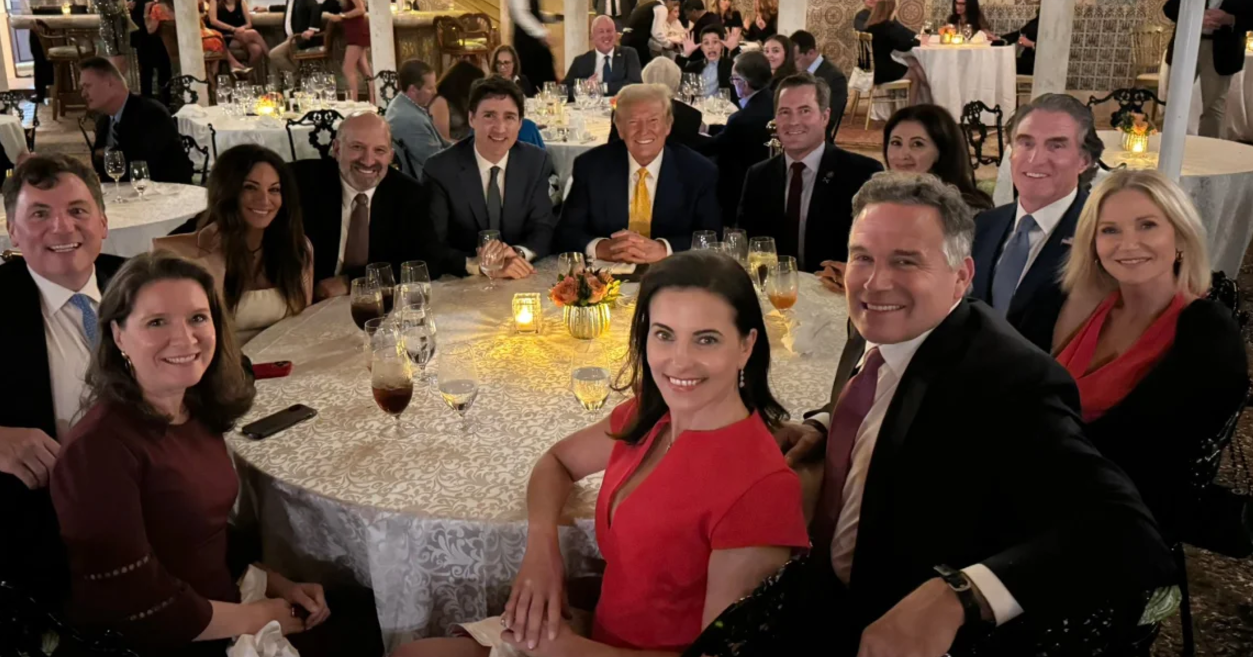
A table setting to be envious of indeed. Trudeau was seated next Trump, surrounded by new Trump appointees important to the US- Canada relationship including Howard Lutnick, Trump's nominee for commerce secretary, North Dakota Governor Doug Burgum, Trump's pick to lead the Interior Department, Mike Waltz and his wife, Trump';s choice to be his national security adviser.


Also, Senator David McCormick and his wife, Dina Powell, a former deputy national security adviser under Trump, as well as Canadian Public Safety Minister Dominic LeBlanc, responsible for border security, and Katie Telford, Trudeau's chief of staff. All smiling! Let’s hope they all knew which fork to use for the salad course. And his mother’s meat loaf was on the menu – a must order for our people!


Our US Ambassador Kirsten Hillman, at an adjacent table, said the atmosphere was “warm," that Trump and Trudeau "get along well" and the dinner was also a chance to socialize. She said Trump used his iPad to play music and she said Trump told Trudeau he is a big fan of Canadian singer Celine Dion. There were no briefing papers and no agenda – not a real working dinner. Clearly Trump enjoyed being the generous host in the crowded main dining room of his Florida palace. Personal relationships are so important - clearly this event worked for Canada. LeBlanc said Trump accompanied his Canadian guests to the door with a warm “keep in touch – we’ll talk soon.”


Trudeau had the floor early on to make his pitch. And knowing the rules for Canadian diplomacy vis-a-vis the most powerful man in the world, you can be sure he emphasized that he was on the same page when it came to the border and fentanyl – two focuses of Trump signaled in his Nov. 25 social media post. There he threatened to impose a 25 per cent tariff on imports from Canada and Mexico until they clamped down on drugs, particularly fentanyl, and migrants crossing the border. Trudeau called Trump the evening it landed and assuredly made his case that the southern and northern borders are entirely different. It was on that call Trump invited his to his Florida mansion for dinner the following Friday as long as it was kept secret.


Notably Trump sought out Trudeau’s views on world leaders who had changed since he was last President. Trudeau is now the senior member of the Group of Seven western leaders. Part of the better relations between the two men can be traced to an earlier personal call from Trudeau to Trump the day after the attempted assassination on July 13, 2024. In addition, Trudeau still has some star power and would be recognizable to Trump’s Florida crowd.


Dominic Leblanc’s read out in several interviews paints an incredibly positive picture of the launch of very strategic high-level lobbying of Trump and his people to find an exemption to the punishing tariff threat. He made a good impression on Lutnick, the incoming Commerce Secretary. He was able to recount the major BC takedown of a huge fentanyl lab. He was very interested in the Chinese source of many chemicals used in its manufacture. Leblanc found Burgum from North Dakota picked to run the interior department who is well briefed on Canada and shared concerns.


The lighthearted nature of the dinner was on display one point when Trump joked that if Canada can't handle the economic

effects of a punishing 25 per cent tariff on its goods, it should become the 51st state of the U.S.!


The Canadians left the Americans with detailed promises to buy more helicopters and drones to provide better surveillance of the large swaths of the undefended border. LeBlanc has invitations to phone the two he talked to most. These kinds of contacts made in a friendly social circumstance are gold. The next day the PM-in-waiting Piere Poilievre was behind a podium branded Fix the Broken Border. He was anything but a Team player for Canada calling the PM “a weak prime minister who’s lost control of our borders, lost control of immigration, lost control of crime and drugs, and lost control of our economy.”


Let’s hope Trudeau is a smart and strong PM, taking the right approach to protect us against Trump’s threats. The Mar a Lago dinner was a great occasion to set out on the right foot.


Patrick Gossage Insider Political Views

By Patrick Gossage March 12, 2026
One of the major differences between these two men is that Carney understands the value of well-thought-out strategy, abundantly clear in his Davos speech, which laid out one for middle powers to deal with the end of a rules-based international order and the rise of hegemony. Trump's lack of strategic understanding is clear in his bumbling attempts to justify the billion-dollar-a-day Iran war. His overall tactic of “flooding the zone” – mounting a new initiative or major announcement every day, or even several times a day to ensure press and opposition can never catch up. This tactic has served him well – confusing the world and his would-be opponents into submission under a valley of activity and harsh opinions from the leader of the world. Contrast this approach to leadership from Carney. He is systematically building a nation less dependent on US trade by travelling the world building new alliances and trading partners. And in the scare of Australia giving substance to his idea of alliances with middle powers. All laid out in the Davos speech. It is instructive to appreciate how much Trump was irritated by the Davos speech. Carney got a standing ovation; Trump’s rambling lengthy diatribe did not. He won’t soon forget being so upstaged. He surely recognized an intellectual power he could never match. Carney is a realist and pragmatic when he stated recently “We take the world as it is, not as we wish it to be.” He is dealing with the world that is being reshaped by an irrational power-mad president, a world the powerful Stephen Miller said “that is governed by strength, that is governed by force, that is governed by power. These are the iron laws of the world.” Does Carney sometimes err on the side of supporting Trump likely to ensure that critical talks on free trade and tariffs have some chance of finding a sympathetic ear? Yes; first he seemed to fully support Trump’s war with Iran. He later made his support more nuanced, saying Trump’s actions were against the rules-based international order. He now says we will not get involved unless a NATO ally is threatened. But generally, Carney is highly rational in contrast to Trump’s self-centered irrationality. Take Trump’s bizarre ill-informed letter to the Prime Minister of Norway, who had no role in deciding if he got the Nobel Peace Prize: “I no longer feel obligated to think purely of Peace (he subsequently engaged in an ever expanding war against Iran). He then reiterated his demand for “complete and Total Control, of Greenland. Thank you!”. His late-night rants, complete with caps, on social media show a mind out of control. Thay are dutifully reported on US news media and often astonish with their non sequiturs and nastiness. One of his more unpresidential quotes came as he fingered White House drapes: “I chose these myself. I always liked gold." The big question for Canadians who are more and more disillusioned with the antics of the President: could these two opposite ever sit down and do a deal that works for Canada. The two do text, and Carney has admitted that in private Trump does listen. But there is also evidence that the trade people in the White House do not like Canada, and as Trump has said, we owe our very existence to the US. And we are “difficult”. They have said that the current trade deal is not good for the US and could be trashed entirely and -deals with Mexico and Canada could be separate and the current trilateral deal may be dead.  Canada was at the brink of reducing the heavy sectoral tariffs on steel, aluminum, and lumber when Premier Ford’s unfortunate ads during the Rose Bowl that featured President Reagan speaking against the usefulness of Tariffs led To Trump suspending talks. They only recently resumed. So can our world-renowned businessman and banker hope to sit down with the unpredictable and unstable President and cut a deal? Some hope that if we extend talks, the President, weakened by the midterms, the bad economic fallout from an unpopular war, and the fragmentation of the MAGA movement may be easier to deal with. On the other hand he may badly need a “win,” bullying big concessions out of Canada and reaping so-cabled benefits from a weaker free trade deal. There is a scenario where Trump gets a black eye if Carney simply walks away with the conviction, perhaps easily shared with an increasingly nationalistic and confident Canada that “no deal is better than a bad deal.” In any case, what a decisive and challenging future we face with Canada at play. Can Carney win for Canada against his opposite by losing a deal?"
By Patrick Gossage December 29, 2025
There has been nothing like the mobilization of our country since we went to war against Hitler “for King and Country.” Now we are mobilizing in a new war against Trump’s depredations with renewed patriotic fervour. Our building a resilient sovereignty against the word’s most irrational and powerful regime - who believe we have no right to exist - will require an enormous dedicated and concentrated effort to redefine our nation. . Make no mistake. We are not seen as important in Washington, a lesson I learned as the Minister of Information at our embassy in the Reagan years. Like Trump’s disparaging attitude to Justin Trudeau, Reagan had little use for his crusading father, Pierre Ytudeau. The difference is that with Prime Minister Brian Mulroney r Reagan actually became a key figure in establishing the Canada-U.S. Free Trade Agreement (FTA), signed in 1988. Ironically, it is precisely the success of this pact that led to 75% of our trade going to the US, a dangerous dependence which is now under extreme threat. The future of the successor to the FTA is at dtake. The US Canada Mexico Agreement (USMCA) is about to be renegotiated and is by no means secure. Bilateral trade discussions on the sectorial tariffs that are destroying our steel, automobile, aluminum and lumber industries were going well but were cancelled on October 23 after Trump, in a fit of pique was annoyed by Ontario TV ads using a Reagan clip to decry tariffs. Prime Minister Carney clings to the hope that these issues will be addressed in the context of the USMCA talks. They are supposed to begin in January. We live in hope. Make no mistake. Trump recently suggested that USMCA’s future was not certain. His strong belief that Canada would be better as a US state _ “and there would be no tariffs” – seems unshakeable. Perhaps the most striking evidence of what low repute Canada is held in the White House comes from Vice President Vance. He has publicly criticized Canada's our generous immigration policies, blaming them for the country's "stagnating" living standards and referring to our approach as "immigration insanity". Vance pointed to a chart from IceCap Asset Management showing that Canada's GDP per capita growth has fallen behind that of the U.S. and the U.K. in recent years. He argues this stagnation is a direct result of Canada's approach to immigration and not U.S. trade policies. He specifically targeted Canada's multiculturalism model, contrasting it with the U.S. "melting pot". Vance claimed that "no nation has leaned more into 'diversity is our strength’... immigration insanity “ than Canada". The White House recently released National Security Strategy (NSS) which also note how immigrants can destroy our democracies. Thomas Friedman, a New York Times columnist signaled this: “It cites activities by our sister European democracies that “undermine political liberty and sovereignty, migration policies that are transforming the continent and creating strife, censorship of free speech and suppression of political opposition, cratering birthrates, and loss of national identities and self-confidence. “‘Should present trends continue,” it goes on, “the continent will be unrecognizable in 20 years or less.” These views are totally inimical to Canadian values.  As is this, Trump’s most outrageous recent anti- immigrant outburst as reported by NBC : “For a second day in a row, President Donald Trump launched into a hate-filled rant against Somalia and Somali immigrants living in the US, saying they’ve “destroyed Minnesota” and “our country.” Minnesota, Trump said, is “a hellhole” right now. “The Somalians should be out of here. They’ve destroyed our country.“ The NSC also can affect Canada in its focus on the Western hemisphere. an area to be dominated by US interests. The US will secure critical supply chains in its own interests; and insists on the right of the US to have access to “strategically important locations.” The US National Security Council is to identify strategic points and resources in the Western hemisphere with a view to their protection and joint development with regional partners. Obviously, Canada as a source of critical minerals, will be under US scrutiny. Some observers fear that Trump wants Canada to become a “vassal state”. A December Toronto Star editorial states coldly that “Thanks to Donald Trump, we know that nothing about our country is guaranteed anymore, not our sovereignty, our democracy, our prosperity.” We now know the Canadian policies standing in the way of a new USMCA agreement. US Trade representative Jamieson Greer said our online Streaming Act, which will make profitable US streaming services support Canadian programming is a major irritant as is our sacrosanct supply management regime for dairy and poultry products. These both are very difficult bargaining chips for Canada to play. Trump’s love affair with tariffs is unlikely to subside so Canadian products may continue to be frozen out of the US. Prime Minister Carney’s ambitious strategy of finding alternate markets for these may work. And his new policy framework for rebuilding a successful economy, major infrastructure projects and attracting important foreign investment is a significant redefinition of our national political priorities. He enjoys wide public support for his strategy which also receives good business and media support. There is already some optimism about the economy in 2026 - take Bank of Montreal’s recent outlook paper: “We’re looking for a stronger economy in 2026 than 2025. Consumer spending has helped prop up the economy. The “Buy Canadian” campaign has helped, and more people are travelling closer to home. Also, there’s no question that federal government spending has also supported economic growth. As we move into the latter part of the year—boosted by firmer economic growth and lower population growth—we expect the unemployment rate to fall in the second half. “Canada’s position in the trade dispute isn’t as bad as it appeared earlier in the year. The average Us tariff rate on imports of Canadian goods is between 6% and 7%, compared to the 17% rate the U.S. charges the rest of the world on average. (these rates are goods under the existing CUSMA) Sectorial tariffs are heavily focused on certain targeted industries, such as steel and aluminum, lumber, and auto imports and non-USMCA auto parts. These are important sectors, but they represent a relatively narrow slice of the economy. “ In addition there is good news on the overall trade front. Canada’s trade swung to a surplus of C$0.15 billion in September 2025 from a C$6.3 billion deficit the month before and well above expectations for a C$4.5 billion deficit, Exports rose 6.3 C$ 64.231 billion, the largest monthly increase since February. Nine of 11 product sections posted gains. Metal and non-metallic mineral product exports jumped 22.7% driven by a 30.2% surge in unwrought gold; aircraft and other transportation equipment rose 23.4% and crude oil exports climbed 5.8%. We just may have a more resilient economy than we thought. Nevertheless, we cannot count on Trump agreeing to a new trade regime that is as good as the original NAFTA – and the cost of reducing tariffs on key sectors may be too high, Trump’s love for tariffs and distain for us won’t change. We can only hope that a smart, well connected and determined Prime Minister can rebuild an economy that will be immune to the vagaries of our neighbour.
More Posts